

"Ravina is a singing lemur (Indri indri) and lives in the Maromizaha, Madagascar rain forest, along with its family and 13 other lemur families of the same species.
Ravina and its like are the only lemurs to communicate through actual singing, which echoes in the forests of Madagascar. This lemur is critically endangered and therefore must absolutely be protected in its natural habitat, which however, due to deforestation, is being threatened.
We therefore ask you to support us to help continue to protect and expand Ravina's habitat along with that of other lemurs, through a reforestation project consisting of 5 hectares and 10,000 plants, by involving local communities and schoolchildren in Maromizaha, Madagascar.
We promise you that Ravina will dedicate a song to you in return.”
***Update***
We have succeeded!
We at the World Sustainability Foundation are happy and proud to have such a motivated and caring community! Thank you because with your contributions we have reached our target! You are fantastic!
You are so good that we have decided to continue fundraising and double the result!
With another 2,500 euros we can plant another 10,000 endemic plants, involve even more local communities, and enable us to reach a total of 20,000 plants in 10 hectares of forest!
Surely Ravina and her relatives will be delighted ?
Help us spread the word and reach the new goal!
***
The Dragon Trees forest of Maromizaha!
Do you know where Ravina lives?
Ravina and other singing lemurs live in the rainforest of Madagascar, where they coexist with many other species, both plant and animal, that are unique throughout the world.
Our singing lemur friends live in a place that has a suggestive name: the Dragon Trees Forest of Maromizaha!
This rainforest is, without a doubt, one of the most fascinating places on the entire island. In fact, with a total extension of 2,150 hectares, over 725 hectares of forest are currently still intact. That is, they have never been affected by human activities. However, deforestation in neighbouring areas is massive, and where there once was a lush virgin forest today there are desolate fields and bare hills.
Singing lemurs live mainly in trees and need the forest to survive!
As a result, our aim is to rebuild their habitat, while contributing to the protection of all the other forest's species.
PS: Ravina is read in Italian as in Malagasy (the language spoken in Madagascar) and it means Leaf, a name that is strongly linked to the sense of reforestation and the fact that the singing lemurs feed mainly on leaves.

What we aim to do thanks to your help
This project is divided into three phases:
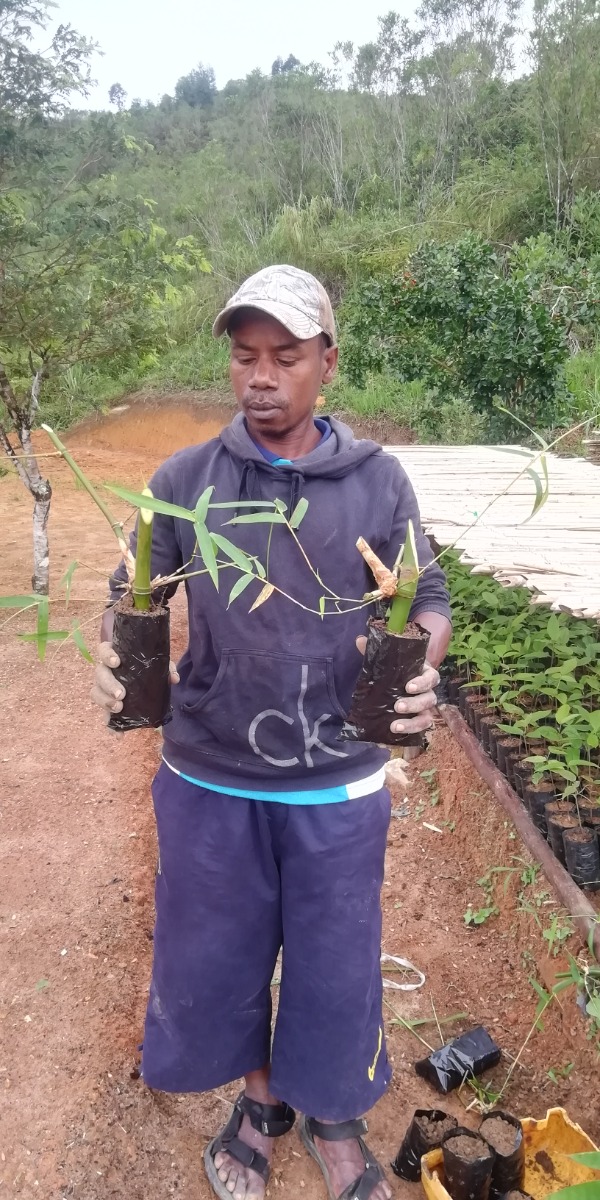
1) The first phase consists of a creation of a nursery, whereby local women go in search of seeds of endemic plants in the forest and sow them in the 5 nurseries (one of which is dedicated to bamboo, whose seeds are both bought in a local market and harvested in the forest). They will therefore need material such as hoes, watering cans and black biodegradable bags where they will put the seeds (pot).
2) The second phase sees the planters coming into action. That is, the nursery technicians who during the year take care of monitoring the growth of the plants in the nursery and then plant the nursery's seedlings in the forest (thus carrying out the actual reforestation).
3) In the third phase, the restoration agents come into play. Their mission is to find places that are suitable for planting and then monitor the rooting of the plants in the various areas.
The objective of this project is to involve the local school's students and teachers, who already have a vegetable garden which they use for recreational/educational purposes. The idea is to ensure that their garden becomes one of the nurseries and that they actively participate in all phases of the project, of which they will become an integral part.

The goal is to replicate the results obtained last year and develop the project on 5 hectares of forest and plant roughly 10,000 trees.
This project began in 2022 and our aim is to continue it. This time, however, we'd like to continue it with you and we could really use your support!

Expenditure items covered by the requested funds
Thanks to your help we will be able to subsidize the following:
- Nurseries (750 euros): we will be able to pay ten local women who will collect the seeds in the forest. Furthermore, we will be able to buy the material we need to plant the seeds and manage the 5 nurseries, such as 10,000 black bags, 2 spades, 2 rakes, 90 bags for transport and possibly other items.
- Planters (500 euros): we will be able to pay the two planters. Additionally, roughly 30 people from the local villages and schoolchildren will be collaborating with us.
- Restoration agents (500 euros): we will be able to pay two nurserymen.
- Awareness: through press releases, interviews, social media posts and more, we aim to promote the results obtained, so as to raise awareness and make people understand how important the protection of lemurs and their habitat is.
- Remote project management: the project management phase is essential for the success of the project itself and therefore we will need resources to manage it.
Timing and technical information
The project will last approximately one year. Reforestation lasts, in total, roughly 8-10 months.
We will be able to send you updates every 2-3 months.

Collaboration with DBIOS (UniTo) and U-ONLUS
As of the beginning of 2022, we have been helping DBIOS and U-ONLUS, through fundraising and awareness-raising activities, to support the monitoring and protection of the population of singing lemurs (Indri indri) through research and education of local communities in the New Protected Area of Maromizaha, in central-eastern Madagascar and through habitat restoration activities.

Commitment and awareness-raising work of the Foundation
We are the World Sustainability Foundation (WSF), a non-profit organization whose aim is to protect and improve the environment by promoting a culture of sustainable development, while protecting and increasing biodiversity through conservation and awareness projects.
The WSF is the non-profit branch of the World Sustainability Organization (WSO), which was founded in 2014 to promote sustainability as a solution to preserve the planet's resources, restore critical habitats and protect endangered species.
The Foundation is already involved in dozens of conservation projects around the world, such as in Mongolia, where we support a project on snow leopards and local communities. In Thailand, we work with researchers to preserve and restore the local coral reef, while in the Galapagos we funded a project on albatrosses and the damage that plastic causes to their health. We also have projects in Italy on butterflies, in Peru on frogs, in Vietnam on pangolins, and many others.

A look at the promoters of the campaign
Mario Passoni: hi, I am a naturalist and traveller and now I am responsible for the WSF's conservation and awareness projects. I worked numerous years in the field, including in the Maldives, Kenya, Mozambique, Mexico, and many other destinations, where I had the privilege of living among sharks, manta rays, whales, but also elephants, cheetahs and crocodiles. During my working experience in Madagascar I fell madly in love with the local biodiversity and was able to see, with my own eyes, the problems lemurs have to face.
Ravina: hello, I am one of the lemur singers of the Maromizaha forest. I am very sociable and everyone knows me. In fact, I love to sing, socialize and eat and I can't wait for my house to get bigger.
Valeria Torti: I am a research technician and I deal with bioacoustics, animal behaviour and biodiversity conservation. I saw the birth of the Maromizaha project from its initial stages and, every year, I spend time in the forest to record and monitor the population of indri and other lemurs. I know all the lemur singers by name and have contributed to the training of many students and doctoral students who have passed through Maromizaha. The Research Centre is my second home and the rangers are my second family.
Cristina Giacoma: years ago I was struck by the charm of the signals emitted by the emerald toad in a pond behind the dunes in Calabria, and since then I have been describing the diversity of various forms and functions found in animal acoustic communication, in search of mechanisms that are not necessarily exclusive to human language. This led me to record the sounds of numerous terrestrial and aquatic species, in Asia and Africa, including the lemur singer. The marvel I experienced led me to promote the creation of a multipurpose research centre in Maromizaha, Madagascar. The centre has made it possible to launch a long-term study, in addition to many initiatives for the conservation of biodiversity and sustainable development, in collaboration with numerous partners.
Paolo Bray: for 30 years now I have been dealing with the protection of endangered species and environmental protection initiatives. I started working in the field of sustainability in the 90s with the Earth Island Institute's Dolphin-Safe Tuna project, of which I am currently the Director. After this experience, I founded Friend of the Sea and Friend of the Earth, the sustainability certification programs headed by the World Sustainability Organization, founder of the non-profit World Sustainability Foundation.

